List of National Holidays in the Philippines 2026
Quick answer: The Philippines has 10 regular holidays and 8 special non-working days confirmed under Proclamation No. 1006 for 2026, plus Eid’l Fitr on March 20 declared separately. February 25 (EDSA Anniversary) is a special working day this year, meaning classes and work continue as normal.
The Philippine holiday calendar catches a lot of travelers off guard. You book a flight, land in Manila, and discover that half the country has left for the coast and the ferry you needed is sold out. Knowing the schedule in advance genuinely changes what is possible. This guide covers every confirmed public holiday in the Philippines for 2026, what each one means, and how to plan your trip around them.
Table of Contents
Who Decides the Philippine Holiday Schedule?
It starts with Congress, which sets the foundational public holidays into law, and ends with Proclamation No. 1006, which President Ferdinand Marcos Jr. signed on September 3, 2025, to confirm the regular holidays and special non-working days for 2026.
A few things are worth knowing before you read the list. First, certain holidays are movable. Marcos Jr. has followed the practice known as holiday economics since taking office, positioning holidays near weekends wherever possible to create longer breaks. The outcome for travelers is predictable: when a holiday falls on a Thursday or Friday, the roads out of Manila get very busy the day before.
Second, Eid al-Fitr and Eid al-Adha are not included in the main proclamation. Their dates depend on the Islamic lunar calendar and are confirmed separately. In 2026, Eid al-Fitr landed on March 20.
Third, mayors and governors can declare their own localised holidays that apply only to their city or province. President Marcos signed six such local proclamations on June 3, 2026, covering areas in Rizal, Cagayan, Davao del Norte, San Juan City, Tabaco City in Albay, and Sawata in Davao del Norte. These do not affect the national schedule.
Regular Holidays in the Philippines 2026
These are the dates on which employees are entitled to full pay, whether they work or not. Those who do work are paid double, at 200% of their daily wage.
Date | Day | Holiday |
January 1 | Thursday | New Year’s Day |
April 2 | Thursday | Maundy Thursday |
April 3 | Friday | Good Friday |
April 9 | Thursday | Araw ng Kagitingan (Day of Valor) |
May 1 | Friday | Labor Day |
June 12 | Friday | Independence Day |
August 31 | Monday | National Heroes’ Day |
November 30 | Monday | Bonifacio Day |
December 25 | Friday | Christmas Day |
December 30 | Wednesday | Rizal Day |
That is 10 regular holidays under Proclamation No. 1006. Eid’l Fitr (March 20) is an 11th regular holiday confirmed through a separate proclamation, with Eid’l Adha still to follow.
Notice how many of these land on a Friday: Good Friday, Labor Day, Independence Day, Christmas Day. Each one creates a natural three-day weekend, which is exactly why accommodation near popular destinations fills up weeks in advance.
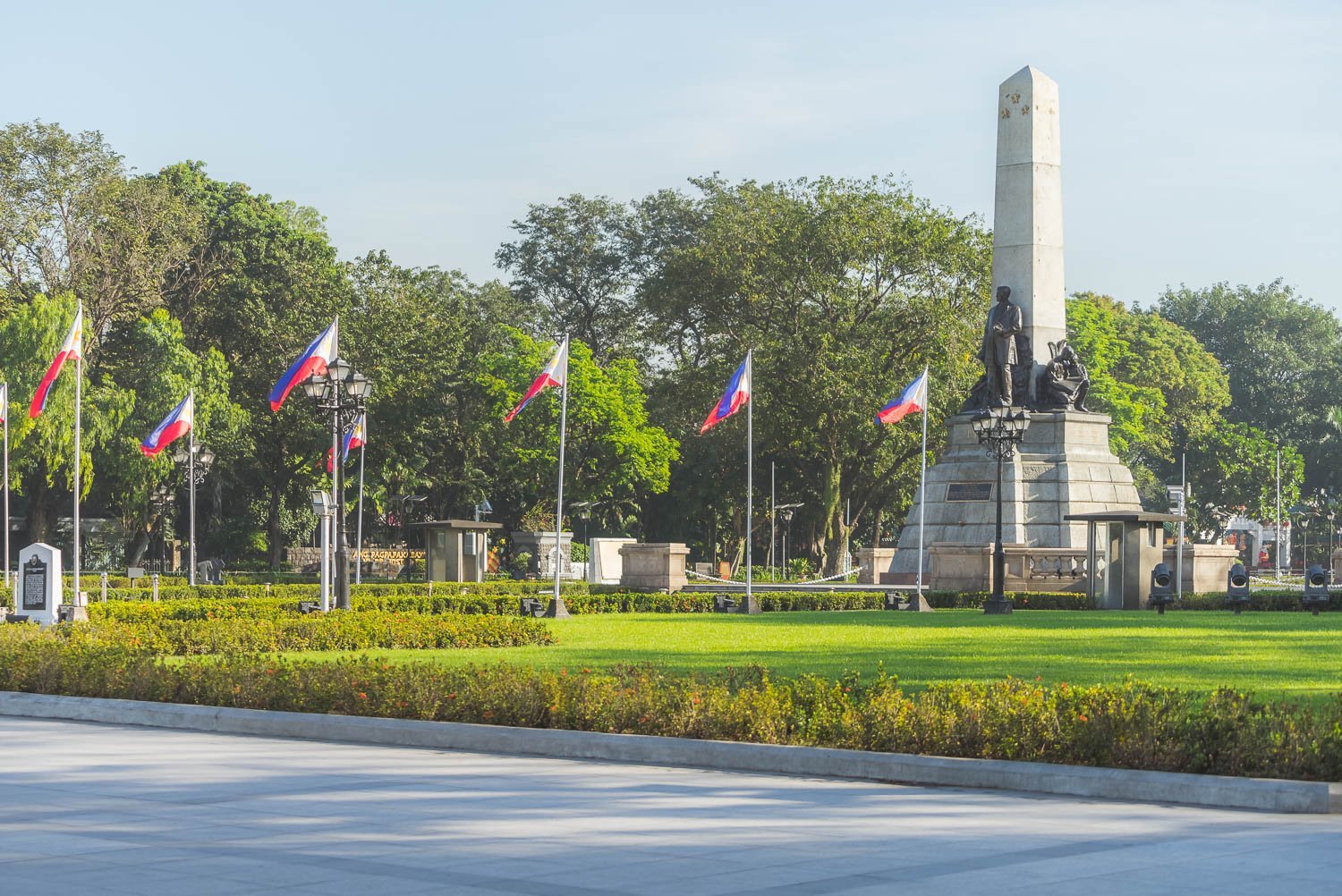
Special Non-Working Days in the Philippines 2026
These are the days when most offices and businesses close, but the pay rules are different. Employees who work on a special non-working day earn an extra 30% on top of their standard daily rate. Those who do not work are generally not paid unless their company policy says otherwise.
Date | Day | Holiday |
February 17 | Tuesday | Chinese New Year |
April 4 | Saturday | Black Saturday |
August 21 | Friday | Ninoy Aquino Day |
November 1 | Sunday | All Saints’ Day |
November 2 | Monday | All Souls’ Day |
December 8 | Tuesday | Feast of the Immaculate Conception of Mary |
December 24 | Thursday | Christmas Eve |
December 31 | Thursday | Last Day of the Year |
That is 8 special non-working days for 2026.
The November 1 and 2 combination is worth flagging. All Saints’ Day and All Souls’ Day are taken seriously across the country. Filipinos visit cemeteries, stay with family, and the mood of the country shifts noticeably. It is one of the more unexpectedly moving things to witness if you happen to be passing through. For context on how Filipinos observe religious and cultural traditions, our culture guide explains the values behind the calendar.
EDSA Anniversary 2026
February 25, 2026, is a special working day, not a holiday. Classes and work continue in all public and private schools and offices. The 40th anniversary of the EDSA People Power Revolution retains its historical significance, but the current administration has classified it as a working day. Worth knowing if your itinerary depends on government offices being open.
Islamic Holidays in 2026
Eid al-Fitr and Eid al-Adha are both classified as regular holidays when they fall. Their dates follow the Islamic (Hijri) lunar calendar, confirmed each year after recommendation from the National Commission on Muslim Filipinos.
For 2026, Eid al-Fitr fell on March 20, a Friday, declared a regular holiday nationwide. It applies across the entire country, not only in Muslim-majority areas of Mindanao, reflecting the Philippines’ broader religious diversity. Eid’l Adha for 2026 has not been confirmed at the time of writing. Check for the separate presidential proclamation closer to the expected date.
Holy Week 2026
Holy Week is the single biggest event on the Philippine holiday calendar in terms of its effect on how the country functions. In 2026, the key dates are:
- Palm Sunday — March 29
- Maundy Thursday — April 2 (regular holiday)
- Good Friday — April 3 (regular holiday)
- Black Saturday — April 4 (special non-working day)
- Easter Sunday — April 5
From Wednesday evening through Black Saturday, most of the country shuts down. Many Filipinos begin travelling home to their provinces from Tuesday, so inter-island ferries and domestic flights get progressively busier through the week before.
Holy Week is one of the most interesting times to be in the Philippines, particularly near Marinduque for the Moriones Festival or in Pampanga for the Senakulo re-enactment. But beach accommodation in El Nido, Boracay, and most of the Visayas becomes nearly impossible to find at short notice. Book early and set expectations accordingly.
Chinese New Year 2026
February 17 is declared a special non-working day nationwide for Chinese New Year. The biggest celebrations happen in Binondo, Manila, the oldest Chinatown in the world: lion dances, firecrackers, temple rituals, and street food worth queuing for. If you are in Manila around this date, planning your time around the Binondo celebrations is well worth it.
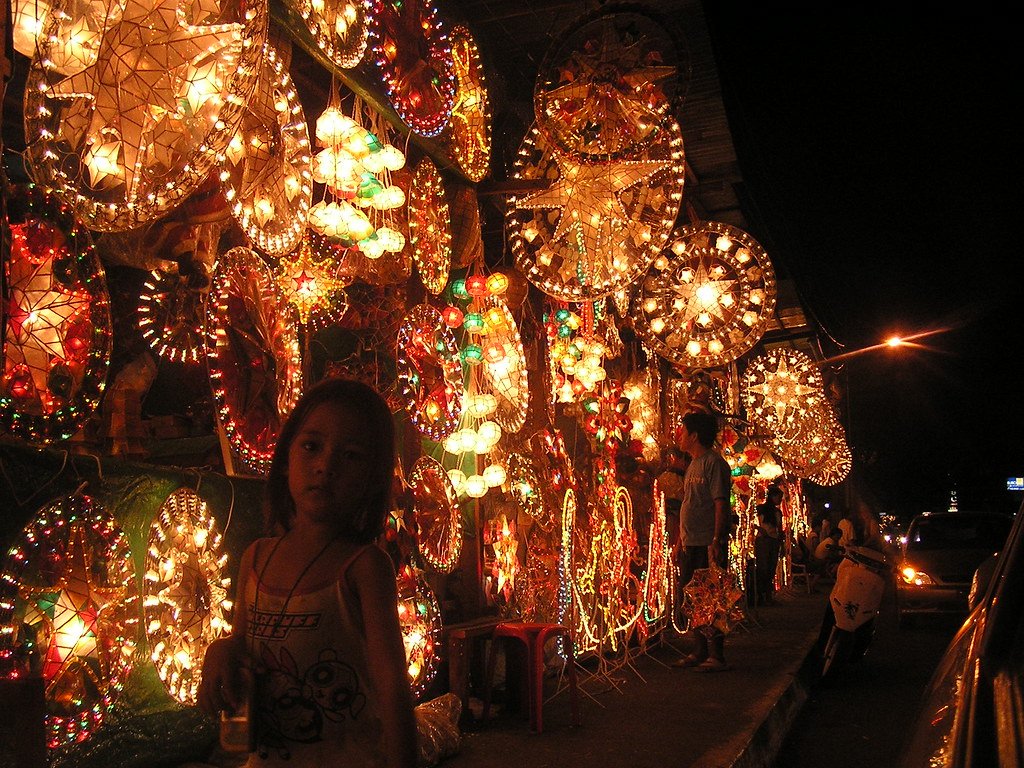
Christmas and New Year in the Philippines
Christmas Day (December 25) and New Year’s Day (January 1) are one week apart, both regular holidays, and together they define the most important period of the Filipino year.
The night before each, shops and malls close early so families can prepare Noche Buena (the Christmas Eve feast) and Media Noche (the New Year’s Eve spread). These are not optional extras. They are the event.
What makes the Philippine Christmas different from anywhere else is the length of it. It begins in September, the first of the “Ber months,” with parols (traditional star-shaped lanterns) going up on front gates and Christmas music in malls. The reason the season runs this long is partly cultural, partly Catholic, and entirely Filipino.
With roughly 80 percent of the population identifying as Roman Catholic, the return home for Christmas is the biggest annual migration event in the country. Balikbayans, Filipinos working abroad, come home specifically for this. Domestic flights, inter-island ferries, and provincial buses are at capacity from mid-December. Book transport as early as possible if your trip overlaps with this period.
How Holiday Pay Works in the Philippines
- Regular Holidays: Employees receive full pay even if they do not work. Those who work on a regular holiday are entitled to double pay (200%).
- Special Non-Working Days: Employees who do not work are generally not paid unless covered by company policy. Employees who work receive an additional 30% premium on top of their regular wage.
- Special Working Days: These are treated as ordinary working days. Employees who render overtime work are entitled to 125% of their regular hourly rate.
These rules are published annually by the Department of Labor and Employment (DOLE) through a labour advisory that accompanies each year’s proclamation.
What This Means if You Are Travelling
Long weekends to plan around in 2026:
- Holy Week: April 1 (Wednesday evening) through April 5
- Labor Day: May 1 to 3 (Friday to Sunday)
- Independence Day: June 12 to 14 (Friday to Sunday)
- National Heroes’ Day: August 29 to 31 (Saturday to Monday)
- All Saints’ and All Souls’ Day: November 1 to 2 (Sunday to Monday)
- Christmas: December 24 to 26 (Thursday to Saturday)
The day before a long weekend is always the worst for traffic out of Manila, Cebu, and other major cities. Leave early or a day ahead if you have the flexibility. Cities actually get quieter during the holiday itself, so a long weekend can be a good time to explore Metro Manila without the usual congestion.
Accommodation near any popular beach or island destination sells out weeks in advance for Holy Week, and even earlier for Christmas. The Philippines travel checklist is worth working through before you start booking. Getting around during peak periods also requires earlier planning than a normal travel day. Jeepney and tricycle fares tend to rise on public holidays, and ride-hailing surge pricing applies in the cities.
Frequently Asked Questions
How many public holidays does the Philippines have in 2026?
Proclamation No. 1006 confirms 10 regular holidays and 8 special non-working days. Eid al-Fitr on March 20 adds an 11th regular holiday, confirmed through a separate proclamation. Eid al-Adha is still to be announced.
Is February 25 a holiday in the Philippines in 2026?
No. The EDSA People Power Anniversary on February 25 is a special working day this year. Work and classes continue as normal in all public and private institutions.
What is the difference between a regular holiday and a special non-working day in the Philippines?
On a regular holiday, you get paid whether you work or not. On a special non-working day, you only get paid if you actually work. Staying home means no pay for that day unless your employer’s policy provides otherwise.
When is Eid al-Adha in 2026?
Not confirmed at the time of writing. The date will be declared through a separate presidential proclamation, recommended by the National Commission on Muslim Filipinos based on the Islamic lunar calendar.
What is the busiest travel period in the Philippines?
Christmas and New Year, roughly mid-December through the first week of January. Holy Week in late March and early April is the second busiest. Both require advance booking to avoid being caught without transport or accommodation.
Are shops and restaurants open on Philippine public holidays?
Government offices and most corporate businesses close. Hotels, restaurants, tourist attractions, and transport operators generally stay open, often with adjusted hours. The exception is the evening before Christmas and New Year’s, when malls and markets close earlier so staff can get home to their families.
Follows us on Facebook
Tips and Tricks
- Bringing Regulated Items
- Transport Options
- Popular Destinations
- Religion in the Philippines
Travel Adventures Diary
- Adventure Tours in Manila
- Adventure Tours on Bantayan Island
- Adventure Tours in Cebu
- Adventure Tours on the Island of Negros
- Adventure Tours Siquijor
- Adventure Tours in Guimaras
- Adventure Tours Gigantes
- Adventure Tours in Metro Manila
- Adventure Tours Puerto Princesa
- Adventure Tours in El Nido
- Adventure Tours in El Nido and Puerto Princesa
- Adventure Tours Baguio City
- Adventure Tours Sagada
- Adventure Tours Buscalan
- Adventure Tours Banaue
- Adventure Tours Pangasinan
- Adventure Tours Hundred Islands
- Adventure Tours in Metro Manila
- Adventure Tours in Leyte
- The Bamboo Paraiso Beach Resort
- Best Tour in Pangasinan