Look, I’m just going to be straight with you about Manila traffic—it’s absolutely brutal. I once spent 90 minutes going 7 kilometers from Makati to the airport during rush hour. Nearly missed my flight. That kind of experience makes you learn real fast which transport option to use when.
After living in Manila for two years and testing every transport option across Metro Manila, Cebu, and Davao, here’s what actually works. No fluff, just the real deal from someone who’s been stuck in that traffic with you.
The transport landscape in the Philippines moves fast — fares, driver allocations, surge policies, and regulatory rulings can change with little notice. While we’ve verified the information in this guide as of early 2026, always check the official LTFRB website and individual app listings for the most current rates and coverage before you travel. If you spot something outdated, let us know in the comments.
Before you read on: Grab yourself a Philippines SIM card as soon as you land—all app-based services are useless without mobile data. And check our currency exchange guide so you have small bills ready for taxis.
Here’s what I typically reach for:
Manila traffic isn’t just bad—it’s legendary bad. According to the 2025 TomTom Traffic Index, Metro Manila motorists lost an average of 143 hours, nearly six full days, to rush-hour traffic in 2025 alone. That 20-minute Google Maps estimate? Triple it during rush hour (7–10 AM and 5–8 PM). I learned this the hard way.
The city has everything from those colorful jeepneys locals love to modern ride-hailing apps. But most visitors—and most locals I know—rotate between the options we’ll cover in this guide. For a broader overview of getting around the capital, see our guide to navigating Manila’s public transport.
Grab bought out Uber back in 2018 and now dominates the four-wheel ride-hailing market in the Philippines. Good news: it works great. Bad news: they know they’re your best option, and the pricing shows it.
The Philippine government regulates them as a Transport Network Vehicle Service (TNVS) under the Land Transportation Franchising and Regulatory Board (LTFRB), which means they must follow certain rules—though enforcement has been inconsistent.
Download the Grab app for iOS or Android, enter your pickup and drop-off locations, and see your fare estimate upfront. The app provides real-time driver tracking and maintains a complete trip history for your records. Payment options include cash, credit/debit cards (Visa, Mastercard, American Express), and the GrabPay digital wallet.
The official base rate is ₱45 to start, then ₱15 per kilometer and ₱2 per minute. Sounds reasonable, right? Wrong. A PCIJ/Global Investigative Journalism Network investigation found that a surge fee is always present on every Grab ride, regardless of time or location—meaning you are never paying only the base LTFRB rate. I’ve watched a ₱120 base ride jump to ₱250 with surge—multiple times.
Note: In late December 2025, the LTFRB temporarily capped surge pricing at 50% under MC 2025-056 through January 4, 2026, following commuter complaints. That holiday cap has since expired, and normal surge pricing applies again.
Strong coverage across Metro Manila and surrounding provinces (Rizal, Cavite, Laguna, Bulacan), Metro Cebu, Davao City, Cagayan de Oro, Iloilo City, and Bacolod City. Coverage drops significantly outside major urban centers.
The safety features are legitimate. GPS tracking means someone always knows where you are. You can share your trip with friends or family in real-time. Every driver is rated, so they actually care about service. If something goes wrong, there’s a record of everything. Cashless payment is also convenient when you’re a tourist who doesn’t yet have enough pesos. No haggling, no “meter’s broken” excuses.
This is where things get genuinely interesting—and a lot more complicated than most travel guides let on.
The Philippines currently has three app-based motorcycle taxi platforms authorized under the government’s Motorcycle Taxi Pilot Study, managed by the LTFRB’s Motorcycle Taxi Technical Working Group (MC Taxi TWG): Angkas, JoyRide, and Move It. All three operate legally, all three provide helmets and insurance, and all three offer GPS-tracked rides.
There’s also the long-standing informal option: habal-habal, the unregulated roadside motorcycle taxis that predate all three apps by decades. We’ll cover all of them.
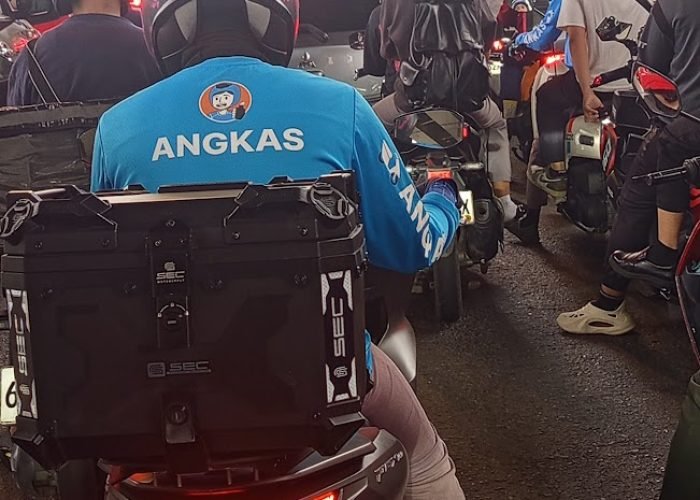
Angkas launched in 2016, fought through years of legal gray areas, and finally gained a firm footing under the pilot program in 2019. As of early 2026, it remains the largest motorcycle taxi service in the Philippines, with over 27,000 active rider-partners and 11 million app downloads, per a January 2026 partnership announcement with insurtech Igloo. That said, Angkas is navigating financial headwinds: its 2024 revenue declined 22% to ₱555 million, and the company underwent layoffs in mid-2025. It continues to operate normally for passengers, but it’s worth having JoyRide and Move It installed as backups.
Download the Angkas app, input your pickup and drop-off points, and confirm your fare before booking. A rider arrives, provides a sanitized helmet and disposable hair cap, and you’re off.
Per the LTFRB motorcycle taxi pilot rate: ₱50 for the first 2km, then ₱10 per kilometer up to 7km, then ₱15 per kilometer beyond that. For a typical 5km ride, expect ₱80–100. Surge pricing exists on Angkas but is minimal compared to Grab.
Cashless only—credit/debit cards, GCash, or Maya (formerly PayMaya). No cash option.
Strongest in Metro Manila. Also operates in Metro Cebu. Limited expansion to other areas compared to JoyRide.
Angkas holds a 99.997% safety rating audited by independent experts, confirmed on the official Angkas About Us page. Every rider undergoes background checks and professional training. Per LTFRB pilot program requirements, Angkas provides Passenger Personal Accident Insurance (PPAI) covering ₱450,000 for death or disablement and ₱30,000 in medical expenses per ride, on a no-fault basis. As of January 2026, Angkas riders are also enrolled in an additional personal accident plan through Igloo insurtech.
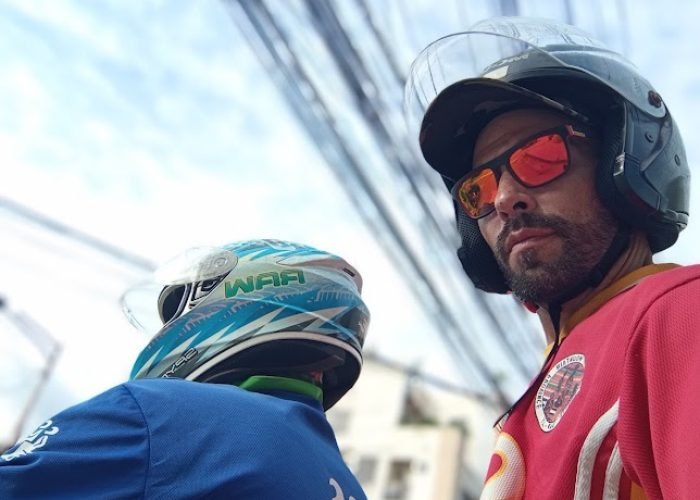
JoyRide launched in December 2019 as one of the two operators greenlit to join the pilot program. It’s entirely Filipino-owned and has expanded into a multi-service “superapp” beyond just motorcycle taxis. As of mid-2025, JoyRide has over 16 million app downloads and has introduced a faster driver-matching algorithm to reduce wait times.
The JoyRide app lets you book an MC Taxi (motorcycle ride), a JoyRide Car (4-seater or 6-seater private vehicle), a regular Taxi Cab, a Super Taxi (with airport transfer pre-booking), food delivery, a “Pabili” (buy-for-me) service, and as of late 2025, JoyRide Bus ticketing—all from one interface, per the App Store listing.
JoyRide maintains a strict no-surge pricing policy since launch, meaning fares are calculated on the shortest Google Maps route and don’t fluctuate with demand. For motorcycle rides, expect rates comparable to Angkas: ₱80–100 for a typical 5km ride. Learn more at the official JoyRide website.
Cash and cashless options (credit/debit cards, GCash)—a real advantage for travelers without e-wallets set up yet.
JoyRide has the widest provincial coverage of the three platforms. Per the official App Store listing, JoyRide is available 24/7 in Metro Manila, Rizal, Bulacan, Cavite, Laguna, Pampanga, Bicol, Cebu, and Cagayan de Oro, with expansion to Ilocos Norte in progress. Particularly useful for travelers venturing to Baguio or Cebu.
JoyRide instituted its JoyRide Update Program in 2023, covering skills training, customer service, gear inspections, and document verification. Helmets, GPS tracking, and insurance are standard. Per the LTFRB pilot program PPAI requirements, JoyRide provides the highest passenger insurance of the three platforms: ₱500,000 for death and ₱50,000 in medical expenses per ride, on a no-fault basis.
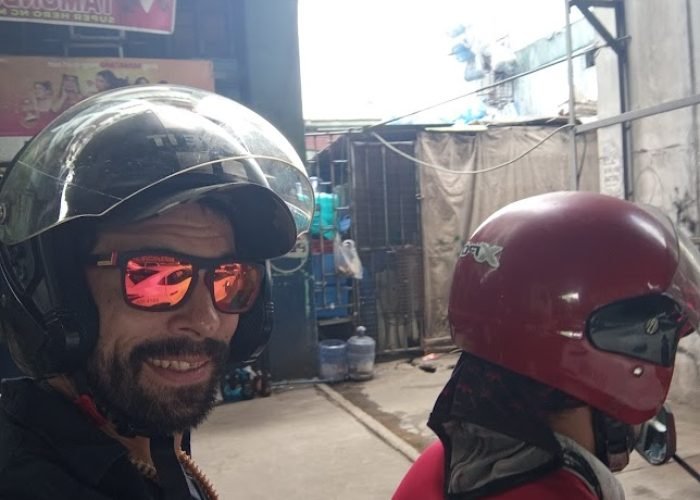
Move It is the newest of the three authorized operators, having launched its upgraded app in 2022. It operates independently of the main Grab app—you book through the Move It app specifically—but Grab Philippines acquired Move It’s business operations in 2022 and provides technical infrastructure, including mapping and safety systems.
Separate app from Grab (Grab credentials and credits don’t transfer). The app uses GrabMaps for precise navigation and includes a Share-My-Ride feature and a 24/7 Safety Centre for emergency assistance.
Base fare of ₱50 for the first 2km, then ₱10 per kilometer up to 7km, then ₱15 per kilometer beyond. Move It also offers a “Mas Murang Rides Guarantee”—if you find a lower per-kilometer rate from an approved competitor, they’ll issue a ride voucher for the difference. This positions them as the most aggressive on price among the three operators. See details at the official Move It website.
Cashless only (credit/debit cards; e-wallet support available).
Metro Manila — confirmed with 6,836 LTFRB-allocated riders. Note: in April 2025, the LTFRB ordered Move It to cease operations in Cebu City and Cagayan de Oro, citing lack of authorization. The DOTr put this on hold pending appeal, but the dispute remained unresolved as of early 2026. Check the Move It app directly before relying on it outside Metro Manila.
Move It integrates Grab’s safety infrastructure: facial authentication for drivers, a 24/7 Safety Centre, and real-time trip sharing. Per LTFRB pilot PPAI requirements, Move It covers ₱200,000 for death and ₱25,000 in medical expenses per ride—the lowest of the three platforms, but still no-fault and mandatory. The company also emphasizes a “Habal-Habal to Legal” initiative, actively recruiting informal motorcycle taxi drivers into its regulated fleet.
No guide to Philippine motorcycle taxis would be complete without acknowledging habal-habal—the informal, roadside-hailed motorcycle taxis that have existed long before any of the apps. In rural areas and provincial towns where jeepneys and buses don’t reach, habal-habal is often the only available transport. For context on how transport works across the islands, see our complete guide to inter-island ferry travel and our guide on navigating provincial bus routes.
If you’re in a provincial or remote area with no app coverage, negotiate your fare before you get on, ask a local for the going rate, confirm a helmet is provided, and use your judgment about the driver and the condition of the motorcycle.
White taxis with colored roofs remain ubiquitous throughout Metro Manila, Cebu, and other major Philippine cities. No app, no internet connection required.
Regular white taxis in Metro Manila: ₱50 flag-down (confirmed under LTFRB order dated March 18, 2024), ₱13.50 per kilometer, and ₱2 per minute in traffic. Note: taxi operators filed a petition to raise the flag-down rate to ₱60, which the LTFRB was still reviewing as of November 2024. Verify current rates before travel. Yellow airport taxis at NAIA: ₱70 flag-down. Coupon taxis at airports offer fixed zone rates. For the latest official rates, check the LTFRB website. Planning to fly in or out? See our NAIA 2026 airport guide for transport tips at the terminal.
Verify the meter is activated before the car moves. If the driver refuses, exit immediately. Note the taxi number and plate before entering. Use official taxi stands at airports, malls, and hotels. Carry small bills. Learn “Pakiusap metro lang” (please use the meter). For more on essential Filipino phrases that’ll help you navigate transport situations, check our dedicated guide.
Use Grab when: It’s late at night with luggage, you need trip-sharing for safety, you’re with a group, or you want the most established support system if something goes wrong.
Use Angkas when: You need the fastest option in Metro Manila rush hour, you’re comfortable going cashless, and you have just a small backpack. With ~27,000 active riders in Metro Manila—the largest pool of the three platforms—you’ll generally get shorter wait times than JoyRide or Move It.
Use JoyRide when: You want no surge pricing at any hour, you’re traveling in a province where JoyRide has coverage, and others don’t, you need to pay cash, or you want the flexibility of switching to a car booking within the same app. Great for Baguio, Cebu, and other provincial destinations where JoyRide has expanded.
Use Move It when: You want to compare fares and claim the lowest-price guarantee, you’re in an area where Move It has strong coverage, or you appreciate enhanced safety tech (facial auth, 24/7 emergency centre).
Use Taxis when: Your phone has no data, you’re splitting the cost among 3–4 people, or both app platforms show zero available drivers.
Use Habal-Habal when: You’re in a rural or remote area with no app coverage and no other option—negotiate the fare upfront, confirm a helmet, and manage risk accordingly. This is common in destinations like El Nido, remote parts of Sagada, and outer islands.
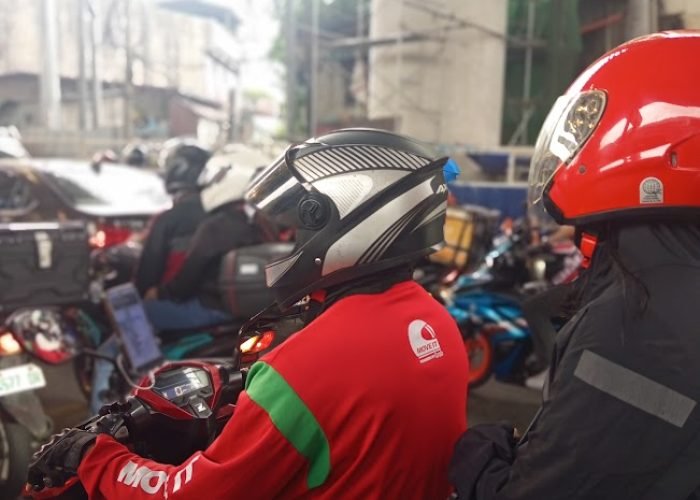
Understanding the LTFRB regulatory environment explains why availability is inconsistent. All three motorcycle taxi platforms operate under a pilot program that the LTFRB has been extending periodically since 2019. There is no permanent law governing motorcycle taxis yet—though the House of Representatives has approved a motorcycle taxi bill, it remains pending in the Senate as of early 2026, per Philstar.
What this means practically: if one app shows no available riders, try the others before giving up on motorcycle taxis entirely.
Metro Manila: All five options (Grab, Angkas, JoyRide, Move It, taxis) operate here. Motorcycle taxis are most valuable during peak hours. For a breakdown of all Manila transport options, see our Metro Manila transport overview.
Metro Cebu: Grab, Angkas, and JoyRide all have a confirmed presence. Move It’s Cebu operations are under a disputed LTFRB suspension order (on hold pending appeal as of early 2026—check the app before relying on it). Cebu taxis are notorious for overcharging tourists—using an app is strongly advisable. See our Cebu City travel guide for more local transport tips.
Baguio and Pampanga: JoyRide has expanded here, where Angkas has limited presence. Grab is available. Taxis and jeepneys remain common. See our Baguio City guide for transport on the ground.
Cagayan de Oro: Angkas and JoyRide operate here. Move It’s CDO operations are under a disputed LTFRB suspension order—check the app for current availability before arriving.
Davao City: Grab operates here. Motorcycle taxi app coverage is more limited—check individual apps for current availability.
Provincial cities and rural areas: Grab availability drops significantly. Motorcycle taxi apps may not be available at all. Tricycles and habal-habal dominate. Check your specific destination before assuming any app-based option works. For exploring areas like El Nido, Puerto Princesa, or the Palawan region, renting a motorbike may be the most practical option entirely.
Share your live location with a trusted contact before traveling. Don’t display expensive electronics, jewelry, or large amounts of cash. Trust your instincts—if something feels wrong, cancel and leave. Download offline maps to verify routes regardless of which service you use. For a comprehensive look at staying safe as a solo traveler, see our guide on risk management for solo adventure travelers, and keep our Philippines emergency contacts guide bookmarked.
For motorcycle rides specifically: wear long pants and closed-toe shoes, secure your backpack, check the weather before booking during the rainy season (May–November)—see our Philippines weather guide to plan around the seasons—and cancel immediately if no proper helmet is provided.
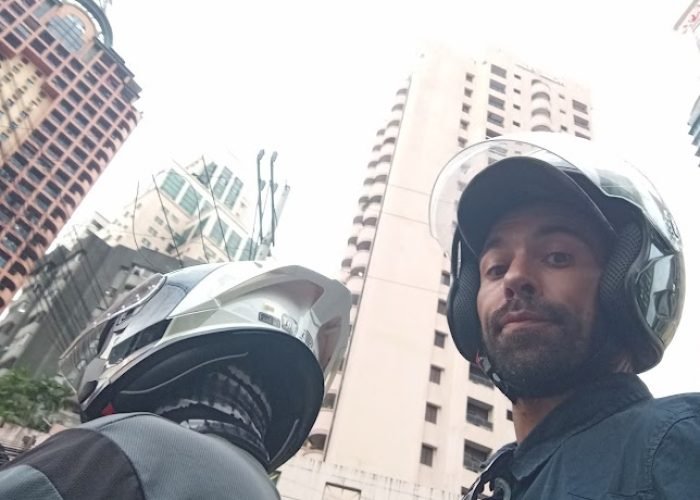
Don’t commit to one option. The smartest approach is knowing which tool fits each situation. Keep Grab for airport runs, late nights, and when you need maximum safety with luggage. Use whichever motorcycle app has the best driver availability in your area—download all three and see which shows riders first. Fall back on taxis when your phone’s dead or you’re with a group.
Before your trip, do this:
Which motorcycle taxi app is the cheapest?
All three—Angkas, JoyRide, and Move It—use similar government-set rate structures: around ₱50 base fare plus ₱10/km up to 7km, then ₱15/km beyond. JoyRide maintains a strict no-surge policy, making it the most predictable. Move It has a lowest-fare guarantee against competitors. In practice, differences are minimal for most rides.
Which motorcycle taxi app is safest?
All three are regulated under the same LTFRB pilot program with mandatory safety requirements: helmets, insurance, GPS tracking, and driver background checks. On passenger insurance, JoyRide provides the highest coverage (₱500,000 death / ₱50,000 medical), followed by Angkas (₱450,000 / ₱30,000), then Move It (₱200,000 / ₱25,000), per LTFRB PPAI requirements. On safety technology, Move It’s integration of facial authentication and a 24/7 Safety Centre gives it the most comprehensive tech stack. Angkas’s longer operational history provides more accumulated safety data.
Is habal-habal safe?
Compared to app-based services, habal-habal carries a meaningfully higher risk: no standardized helmets, no insurance, no driver vetting, no GPS tracking, and no recourse. In areas with app coverage, there’s no compelling reason to use informal habal-habal. In rural areas with no app coverage, manage risk by negotiating fares upfront, confirming helmet provision, and assessing the driver and vehicle condition before riding.
Can foreign tourists use all three motorcycle taxi apps?
Yes. All accept international phone numbers for registration and support international credit/debit cards. Angkas and Move It are cashless only; JoyRide also accepts cash. Make sure you have a working Philippine SIM card before trying to book.
What’s the regulatory status of motorcycle taxis?
They operate under a government pilot program that has been extended periodically since 2019 by the LTFRB. No permanent law has been passed yet—the House of Representatives approved a motorcycle taxi bill, but as of early 2026, it remains pending in the Senate. The MC Taxi TWG sets and adjusts unit allocations for each operator. Industry stakeholders, including all three operators and lawmakers, continue to push for a permanent legal framework.
Take Note that the motorcycle taxi landscape in the Philippines continues to evolve rapidly.


Philippines Travel Guide seeks to share the vibe of an authentic experience through our idea of adventure travel for explorers and memory seekers in the Philippines.


Subscribe our newsletter for more update & news !!
Copyright © 2024. All rights reserved by Philippines Travel Guide.