Filipino mountains, beaches, and forests offer some of Southeast Asia‘s most spectacular camping experiences. But between DENR permits, indigenous community protocols, and the 2026 weekend camping ban at Mt. Pulag, navigating Philippine camping regulations gets confusing fast. This guide covers everything you need to know before you head out.
Registration and a medical certificate are required for protected areas. The best camping season runs from November to April during dry months. Top destinations include Mt. Pulag, Anawangin Cove, Sagada, and Mount Apo. Essential gear includes a 4-season tent, a sleeping bag rated to 0°C, water purification, and a headlamp.
Also worth noting: many camping areas are cash-only, so plan your budget and exchange currency before heading to remote sites. Check out the Philippines Currency Exchange Guide and make sure you have a local SIM card for registrations and emergencies — see the Philippines SIM Cards Guide.
Camping in the Philippines falls under multiple regulatory bodies. The Department of Environment and Natural Resources (DENR) oversees all protected areas, national parks, and forest lands, while local government units (LGUs) manage beach campsites and private property.
The DENR regulates camping through Presidential Decree 705 (Revised Forestry Code) and Republic Act 7586 (National Integrated Protected Areas System or NIPAS Act). These laws designate protected areas managed by Protected Area Management Boards (PAMB). Camping on timberland or within protected areas technically requires a Special Land Use Permit (SLUP) or Special Use Agreement in Protected Areas (SAPA). However, individual campers rarely apply for these directly — registered tour operators and local government tourism offices handle bulk permits for established campsites.
Here is what confuses most first-timers. Registration means showing up at the DENR office or ranger station, filling out forms, attending orientation, and paying conservation fees. This applies to casual camping at established sites like Mt. Pulag, Mount Apo, and most provincial campsites. Fees typically range from ₱50 to ₱ 500 per person, depending on location.
Permits are formal authorizations required for commercial operations, large groups (typically 20+ people), or establishing new campsites on forest land. Unless you are organizing a large group event or opening a glamping resort, you won’t need these.
Each national park has a PAMO (Protected Area Management Office) handling registrations and enforcement. For example, Mt. Pulag National Park‘s PAMO in Kabayan, Benguet, processes all camping applications. You must register online or in person, provide a valid ID, and attend a mandatory environmental briefing before accessing the trails.
Recent regulations require a “Fit to Climb” medical certificate issued by a licensed physician, confirming you’re physically capable of high-altitude camping. This applies to mountains exceeding 2,000 meters above sea level, primarily in the Cordillera Administrative Region.
Beach campsites like Anawangin Cove in Zambales or Calaguas Island in Camarines Norte fall under municipal jurisdiction. Registration happens through local tourism offices or barangay (village) captains. You’ll pay a beach entrance fee (₱50–150), environmental fee (₱50–100), and sometimes a camping fee (₱50–200 per tent). Some municipalities require booking, especially during peak season from December through May.
Many prime camping areas sit within ancestral domains protected by the Indigenous Peoples’ Rights Act (IPRA, RA 8371). The National Commission on Indigenous Peoples (NCIP) requires Free and Prior Informed Consent (FPIC) for activities affecting indigenous communities. At Mt. Pulag, the Ibaloi and Kankana-ey peoples share cultural protocols during orientation — respecting sacred spaces, maintaining silence near burial sites, and following local spiritual guidelines. Violating these can result in expulsion and a ban from the area.
The most significant regulatory change for 2026 is Mt. Pulag’s strict weekend camping prohibition at Camp 2 (Friday–Sunday) to allow ecosystem recovery. Hikers must now use accredited homestays at Babadak Ranger Station on weekends, then attempt a pre-dawn summit assault starting around 1:00 AM. Weekday campers (Monday–Thursday) still enjoy overnight stays on the mountain. Book well in advance — weekday slots fill up months ahead.
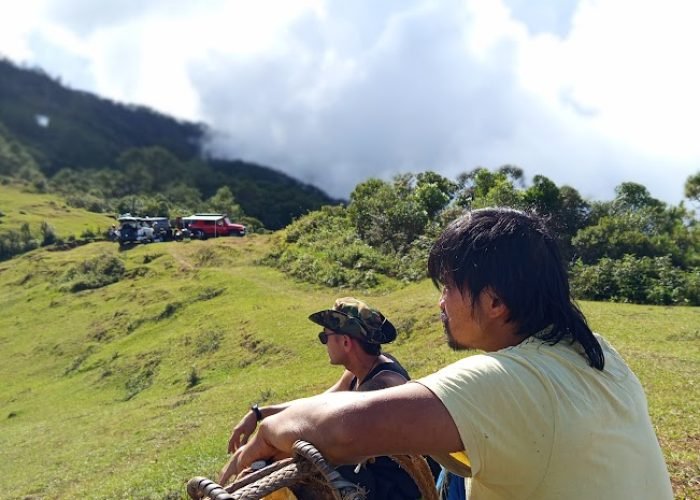
At 2,926 meters above sea level, Mt. Pulag is Luzon’s highest peak and the Filipino hiker’s rite of passage. The Ambangeg Trail (easiest, 4–5 hours to summit) attracts beginners, while the Akiki Trail (6–8 hours) challenges experienced trekkers. The Tawangan Trail offers a less-crowded alternative through mossy forests.
What makes Pulag exceptional is its ecological zonation — you start in Benguet pine forests, transition through damp mossy forests above 2,300 meters, then emerge onto dwarf bamboo grasslands at the summit. Temperatures drop to near-freezing overnight, sometimes hitting -2°C to 5°C. A sleeping bag rated for 0°C or colder is mandatory.
The famous sea of clouds phenomenon occurs when temperature inversions trap mist below the summit, creating a stunning ocean-like vista at sunrise. Current 2026 regulations include a medical certificate requirement, weekend camping ban at Camp 2, silence policy near sacred areas, no campfires, and a compulsory environmental briefing.
Pulag pairs well with nearby Mountain Province destinations. Learn more in the Sagada Travel Guide.
Anawangin’s volcanic ash shores create a unique temperate-forest-meets-beach vibe just 4–5 hours from Metro Manila, including the boat ride from Pundaquit, San Antonio in Zambales. Agoho trees resembling pines line the cove, a legacy of the 1991 Mt. Pinatubo eruption.
The cove has no electricity and no freshwater — bring power banks and drinking water. Register at the barangay hall in Pundaquit and follow strict Leave No Trace enforcement. Nagsasa Cove nearby offers a quieter alternative with fewer crowds.
Calaguas delivers some of the Philippines’ finest white sand beaches in a gloriously undeveloped setting in Camarines Norte. No resorts, no restaurants, no electricity. Access requires a 3-hour bus to Daet plus a 1–2 hour boat ride, with total costs around ₱1,500–2,500. Best season runs March–May when seas are calmest.
The remoteness is the point. You’re camping on one of the country’s most beautiful beaches with nothing but coconut palms, turquoise water, and fellow campers. Logistical challenges include limited boat schedules, no phone signal, and medical emergencies requiring boat evacuation. Consider joining organized tours from Daet that handle group logistics.
At 2,954 meters, Mount Apo holds the crown as the tallest Philippine mountain. This dormant stratovolcano in Davao features sulfur vents, Lake Venado at 2,900 meters, and over 200 bird species, including the critically endangered Philippine Eagle.
Most climbers use the Kidapawan Trail or the Santa Cruz Trail (both 2–3 days). Mandatory guide fees run ₱1,500–2,500 per group. Monthly quotas are enforced, so book in advance. The Mt. Apo Natural Park designation means stricter conservation rules, with fines up to ₱50,000 for violations under RA 9147.
El Nido offers beachfront camping without the infrastructure of established campsites. You’re literally sleeping under coconut palms with waves lapping the shore — accessed via island hopping tours from El Nido town. Camping fees run around ₱100–300. For a fuller picture of the area, see the El Nido Adventure Tours Guide.
Mount Makiling in Laguna, managed by the University of the Philippines Los Baños through the Makiling Center for Mountain Ecosystems (MCME), provides Metro Manila residents easy access to forest camping at 1,090 meters. Features include over 400 plant species, cool mountain springs, and affordable fees of ₱50–100. Check the UPLB MCME Facebook page for current schedules before planning your trip.
Mount Ulap, Benguet — easy to moderate trails with Cordillera mountain views and pine forests.
Hamiguitan Range, Davao Oriental — a UNESCO World Heritage pygmy forest with unique vegetation. Permits and guides required.
Buscalan, Kalinga — combine camping near Apo Whang-Od’s village with cultural immersion. See the Buscalan Tours Guide for details.
Mount Banahaw, Quezon — a sacred mountain with waterfalls and natural springs, currently under rehabilitation. Verify access status before planning.
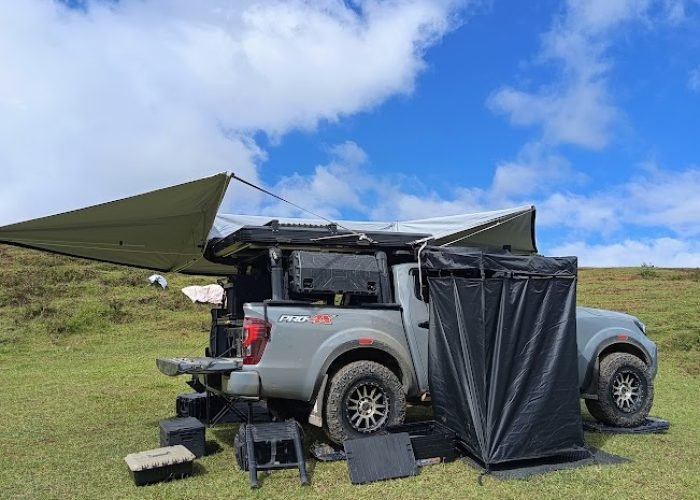
Philippine camping demands equipment that handles humidity, sudden rain, and temperature extremes — from freezing highlands to sweltering lowlands. Here’s what actually works.
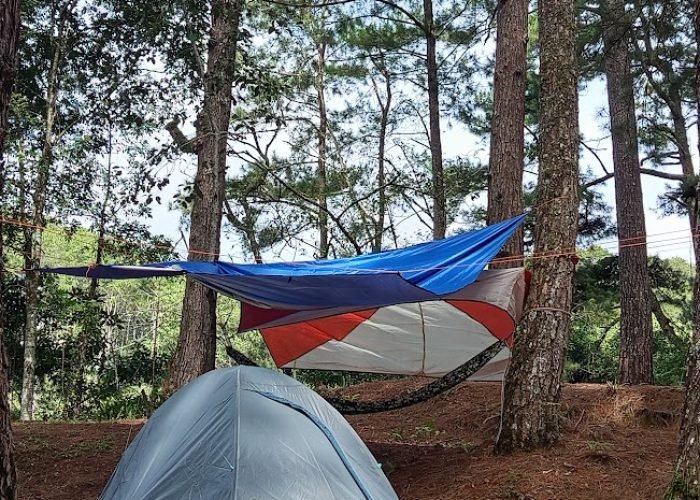
Your tent needs to handle both tropical downpours and freezing mountain nights. Look for 4-season or 3-season tents with good ventilation. Critical features include a waterproof rainfly with a minimum 1,500mm rating (preferably 3,000mm), mesh panels for airflow, a freestanding design for rocky ground, and vestibules for wet gear storage.
Philippine humidity breeds mold aggressively. Air out your tent completely after each trip and never pack wet gear.
Sleeping bag temperature ratings matter: highland camping at Pulag or Apo requires 0°C to -5°C; midland camping at Makiling or Ulap needs 5°C to 10°C; beach camping works with just a sleeping bag liner or light quilt. Synthetic insulation outperforms down in the Philippine humidity since it retains warmth when damp and dries faster.
The layer system works in Philippine conditions. Use a merino wool or synthetic moisture-wicking base layer — cotton retains moisture and takes forever to dry. Add a fleece or synthetic mid-layer for high-altitude camping, and a waterproof shell jacket with good ventilation for your outer layer. Keep a separate dry set for sleeping and never sleep in sweaty hiking clothes.
For footwear, waterproof hiking boots with ankle support work best for mountain trails. Always bring sandals or flip-flops for camp and water crossings.
Carry a minimum 3-liter capacity. Never trust natural water sources in the Philippines without treatment. A UV purifier works fast and effectively. A lightweight squeeze filter is reliable with no batteries needed. Chlorine tablets serve as a solid backup. Boiling remains the most reliable method if you’re cooking — let water boil for 3 minutes at high altitude.
Canister stoves work best in the Philippines. LPG canisters are available at hardware stores nationwide for ₱100–200. Wood fires are banned in most protected areas and often prohibited during the dry season. Don’t count on campfires. Bring dehydrated meals, instant noodles, canned goods, and energy bars.
Download offline maps before heading out. Don’t rely solely on phone navigation. Smart and Globe have the best coverage in the Philippines. Bring a power bank (20,000mAh minimum) and an emergency whistle — three short blasts is the international distress signal.
Your first aid kit should include bandages, antiseptic (Betadine, alcohol), pain relief (ibuprofen, paracetamol), antidiarrheal (loperamide — critical in the Philippines), antihistamine, blister treatment, tweezers, and an emergency blanket.
Pack biodegradable soap and use it at least 200 feet from water sources. Bring heavy-duty trash bags for packing out all waste — Leave No Trace is the law in protected areas, not just a guideline.
For comprehensive packing strategies, check out the Ultimate Philippines Packing List.
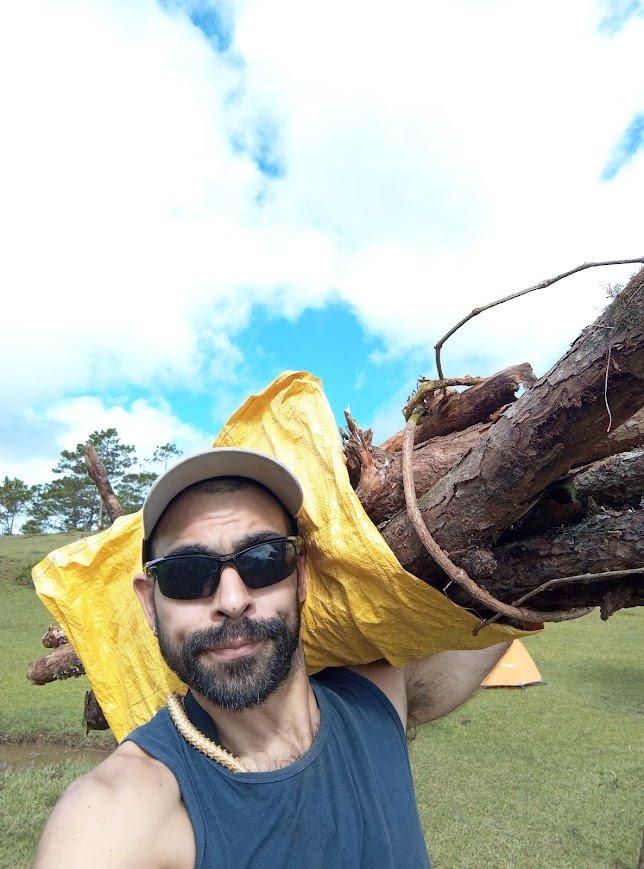
Leave No Trace guidelines aren’t optional suggestions — they’re requirements enforced through fines and area closures in Philippine protected areas.
Before you go, file an itinerary with someone not on the trip, research evacuation routes, and know the location of the nearest medical facility. Philippine Emergency Contacts to have on hand include: 911 (National Emergency Hotline), 117 (Philippine National Police), the DENR hotline at 8929-6626, and DOH Health Emergency at 1555.
For comprehensive safety planning, read the guide on Safety and Risk Management for Solo Travelers.
The best months run from December through March — minimal rainfall, clear skies, and cooler temperatures. This is peak tourist season, so expect crowded campsites and higher transport costs. Highland camping at Pulag and Apo sees temperatures drop to near-freezing; prepare accordingly.
Heavy rainfall, typhoon season peaking in August–October, high humidity, and landslide risk in the mountains. Many areas are closed or have restricted access. Beach camping remains possible during lulls, but monitor the weather closely.
The Philippines experiences 20+ typhoons annually. Monitor PAGASA forecasts religiously. Signal 1–2 means prepare and consider postponing. Signal 3 and above — cancel immediately. Never camp during a typhoon. For detailed seasonal information, see the Weather in the Philippines guide.
April–May is hot and increasingly humid, but still manageable. October–November sees rainfall decreasing before crowds arrive — often a sweet spot for savvy campers.
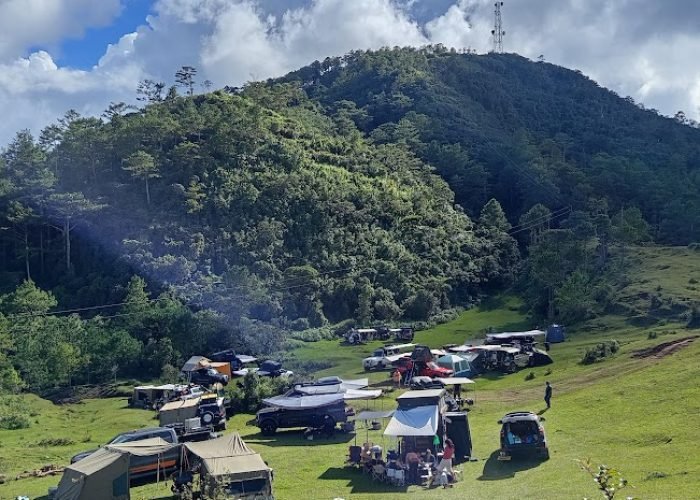
Start with day hikes without overnight stays to test gear and build fitness. Then join organized tours where companies handle permits, food, and equipment rental. Move on to easy beach camping at Anawangin Cove — a forgiving, low-stakes environment. Progress to moderate mountain camping at Mt. Ulap or lower peaks with established campsites. Finally, attempt challenging expeditions like Mt. Pulag or Mt. Apo after building solid experience.
First-time hiking in the Philippines? Read this Complete Beginner’s Hiking Guide before you go.
The Filipino outdoor community is welcoming to newcomers. Join Facebook groups like Climb The Rocks Philippines, Philippine Trail Runners, Women Outdoor Enthusiasts PH, and Solo Backpackers PH. Organizations like the Mountaineering Federation of the Philippines (MFPI) and the Sagada Environmental Guides Association are also excellent resources.
Respect local communities. Greet locals politely — “magandang umaga” means good morning. Ask permission before photographing people or homes, support local businesses by hiring guides and buying from sari-sari stores, and follow community rules around quiet hours and dress codes. For a deeper cultural context, read about Filipino Hospitality and Customs.
Camping in the Philippines rewards preparation with unforgettable experiences — from freezing pre-dawn hikes chasing the Mt. Pulag sea of clouds to falling asleep to waves at Anawangin’s volcanic shores. Understanding regulations, packing proper gear, and following Leave No Trace principles ensure these areas remain pristine for future generations.
Start small, build skills progressively, and join the growing community of Filipino outdoor enthusiasts committed to sustainable adventure. Before your first trip, check out the Philippines Travel Guide and the Best Philippines Destinations by Month for optimal trip timing.
Protected areas and national parks require DENR registration and environmental fees (₱50–500). Permits for commercial operations or large groups differ from individual camping registration. Most established campsites handle registration on-site.
November through March offers the best weather — minimal rain, clear skies, and cooler temperatures. December–February is peak season with crowds. April–May gets hot. Avoid the June–October typhoon season.
Yes, with proper preparation. Register with authorities, inform people of your itinerary, check weather forecasts, bring appropriate gear, and follow safety guidelines. Solo camping is possible, but joining a group reduces risk.
Budget ₱500–2,000 per person for registration fees, permits, guide fees, and transport. Add gear rental (₱500–1,500) if you don’t own equipment. Organized tours run ₱2,500–5,000, including everything.
Yes. Foreign tourists follow the same registration requirements as Filipino citizens. Bring your passport for registration and pay the same fees.
Pack out ALL trash — this is the law in protected areas. Burn nothing. Bury human waste in catholes 6–8 inches deep, 200 feet from water. Violations can result in fines of ₱5,000–50,000.
Most protected areas ban campfires. Use camp stoves instead. Some beach campsites permit fires in designated rings — confirm first. Dry season may bring total fire bans.
Hypothermia at high altitudes, heat exhaustion in lowlands, sudden weather changes, flash floods during rain, venomous snakes (rare but present), cliffs without guardrails, and slippery trails after rain.
Mt. Pulag via the Ambangeg Trail is beginner-friendly but requires decent fitness. First-timers often join organized tours. The medical certificate requirement and altitude make preparation essential.


Philippines Travel Guide seeks to share the vibe of an authentic experience through our idea of adventure travel for explorers and memory seekers in the Philippines.


Subscribe our newsletter for more update & news !!
Copyright © 2024. All rights reserved by Philippines Travel Guide.